

Construction Joint Waterproofing: Waterstops, Sealants and Injection Options
A construction joint forms where one concrete placement ends and another begins. Unlike a random crack, it is planned—but it still interrupts the concrete and can become a direct path for water. Reliable construction joint waterproofing in Sri Lanka starts with reinforcement, waterstop and pour-sequence drawings rather than a repair after leakage begins.
Basements, retaining walls, lift wells, tanks and pools face the highest consequences because joints may remain under water pressure. A single displaced waterstop or honeycombed edge can compromise an otherwise sound structure.
How water moves through a construction joint
Water follows connected pores, voids and gaps between concrete pours. Poor consolidation around congested reinforcement, laitance on the first pour, debris in the joint and shrinkage can all create a route. Hydrostatic pressure then drives water through the weakest connected path.
PVC and rubber waterstops
A waterstop crosses the joint and lengthens the path water must travel. Internal profiles sit within the concrete; external profiles sit against one face. Ribbed sections improve anchorage, and centre bulbs can accommodate movement in expansion joints when the selected profile is designed for it.
Installation quality is critical. Secure the waterstop so it does not fold or shift during the pour, use proper factory-made intersections or welded joints, and compact concrete carefully around both sides without damaging the profile.
Hydrophilic strips
Hydrophilic waterstops swell when exposed to water and seal against the surrounding concrete. They are compact and useful for selected non-moving construction joints, pipe entries and complex details. They need adequate concrete cover and secure fixing on a clean, stable surface.
Premature wetting before the second pour can cause unwanted expansion. A hydrophilic strip should not bridge large voids, replace poor concrete consolidation or be used across a movement joint unless its documented use supports that condition.
Injectable hose systems
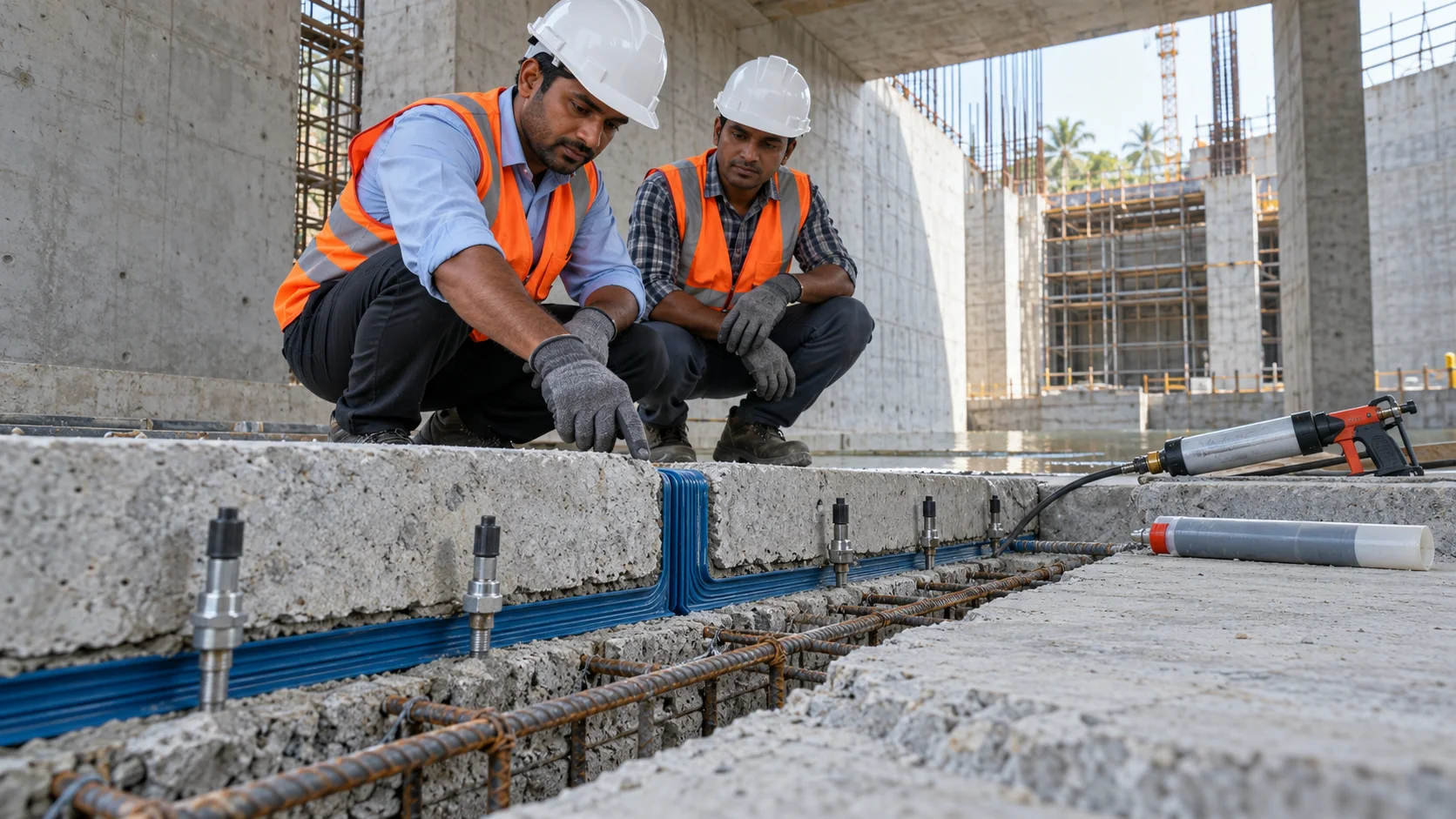
An injection hose installed along a joint creates a controlled route for resin or cementitious grout if leakage appears later. It can complement a primary waterstop where the consequence of failure justifies repair access. Position and protect the hose so concrete paste cannot block it during the pour.
Surface sealants and joint bands
Accessible joints may use elastic sealants or bonded joint-band systems at the surface. These details must accommodate the expected movement and adhere to prepared joint faces. Backer rods control sealant depth and prevent three-sided adhesion.
Choose the joint detail from the exposure
- Water pressure and whether it acts continuously or intermittently
- Expected joint movement, shrinkage and thermal change
- Concrete thickness, reinforcement congestion and pour access
- Whether one or both faces will remain accessible
- Contact with potable water, chemicals or seawater
- The consequence of leakage and ability to repair it later
Site controls before and during concreting
- Approve coordinated joint and waterstop shop drawings.
- Inspect continuity, supports, intersections and penetrations before the pour.
- Prepare the first-pour surface and remove laitance and debris.
- Provide enough access to place and compact concrete around the detail.
- Monitor the waterstop while concrete is discharged and vibrated.
- Record the concealed installation with photographs and inspection reports.
How to repair a leaking construction joint
Map the leak and determine whether water follows the joint, a nearby crack or porous concrete. Polyurethane injection can seal active water paths; cementitious grout may fill larger stable voids; surface bands can accommodate movement at accessible joints. Structural or recurring movement requires engineering review.
Injection pressure, packer spacing and resin reaction time must suit the joint. Sealing one outlet without filling the connected path can push water to another location, so monitor the sequence and inspect after water conditions return.
Common construction-joint failures
- Waterstop laps are left unsealed or intersections are improvised
- The profile folds, floats or tears during concreting
- Hydrophilic material expands before it is confined
- Debris and laitance prevent a sound second pour
- Concrete honeycombs around the joint and reinforcement
- A rigid detail is used where the joint needs to move
Construction joint waterproofing FAQs
- Is a construction joint the same as an expansion joint?
- No. A construction joint separates concrete placements, while an expansion or movement joint is designed to open, close or shear. Movement joints need details that tolerate the calculated movement.
- Can a waterstop be repaired after concrete is poured?
- A buried waterstop is difficult to access. Leakage may be treated by injection or an accessible surface system, but the repair should follow investigation of the actual water path.
- Should a project use both a waterstop and an injection hose?
- High-risk structures sometimes use a primary waterstop with an injectable backup. The designer should justify the combination from exposure, consequence and future access.
Joint waterproofing and remedial injection
H.E. Engineering installs waterstops, joint sealants and waterproofing systems and provides polyurethane, epoxy and cementitious injection grouting across Sri Lanka and the Maldives. Early specialist input helps project teams resolve congested and high-risk joints before concrete placement.