

Why Concrete Cracks — and When You Should Be Concerned
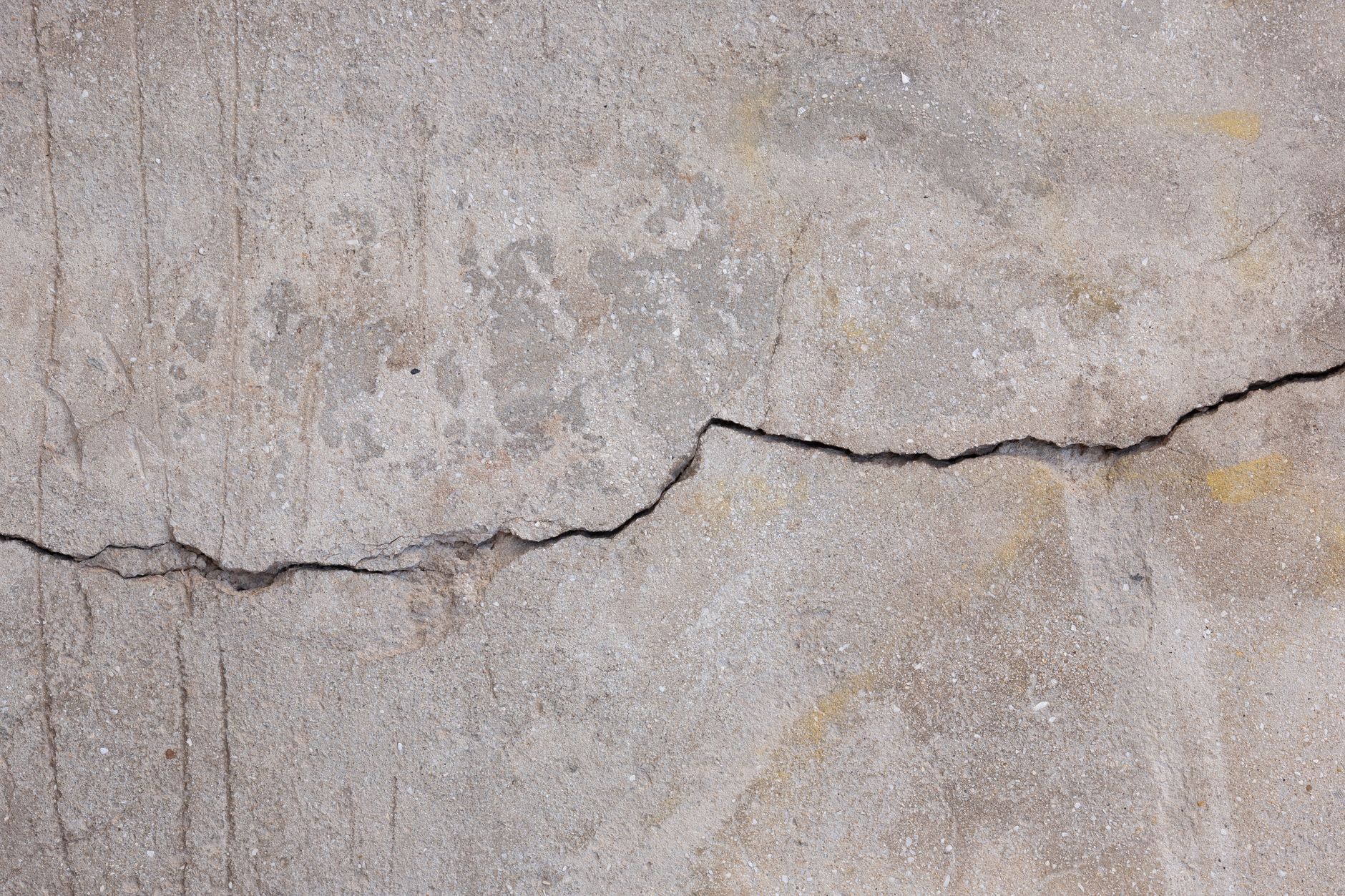
Concrete is strong, durable and fundamental to modern construction, but it is not immune to cracking. Some cracks are a normal consequence of shrinkage and movement. Others indicate water ingress, corrosion, settlement, overloading or deterioration that deserves closer investigation.
The important question is not simply whether a crack exists. It is why it formed, whether it is moving, what it passes through and what other symptoms are present.
Why concrete cracks
Plastic shrinkage
Fresh concrete can lose moisture rapidly from its surface, particularly in hot or windy conditions. If evaporation occurs faster than moisture can rise within the concrete, shallow cracks may form before the concrete has fully hardened.
Drying shrinkage
Concrete generally contracts as it dries. Restraint from reinforcement, adjacent elements or geometry can convert that movement into tensile stress and cracking.
Thermal movement
Roofs, façades and exposed concrete heat and cool throughout the day. Temperature changes cause expansion and contraction. Where movement is restrained or joints are poorly arranged, cracking can occur.
Settlement and movement
Differential settlement of foundations or movement between building elements can produce cracks in concrete and masonry. These defects should be considered in the context of the whole structure rather than repaired cosmetically without investigation.
Loading
Loads create stresses in structural elements. Cracking can be part of normal reinforced-concrete behaviour within design limits, but unusual crack patterns, excessive widths, deformation or new cracks should be assessed by a suitably qualified professional.
Reinforcement corrosion
When embedded steel corrodes, the corrosion products occupy more volume than the original steel. This expansion can crack the surrounding concrete, cause delamination and eventually lead to spalling.
Water ingress, carbonation and chloride exposure can contribute to corrosion risk, particularly in coastal or aggressive environments.
When should a crack concern you?
No blog article can determine structural safety from appearance alone. However, several signs justify professional assessment:
- a crack is widening or lengthening
- it appeared suddenly
- there is visible displacement across the crack
- the element is sagging or distorted
- concrete is spalling
- reinforcement is visible
- rust staining is present
- water actively enters through the crack
- several related cracks form a distinct pattern; or
- the crack is in a critical structural element.
If structural significance is uncertain, an engineer should assess it before cosmetic repair.
Active versus dormant cracks
A key repair question is whether the crack is still moving.
A dormant crack has stabilised. Depending on its location and purpose, it may be repaired with a rigid material.
An active crack continues to open, close or move. A rigid repair across an active joint can crack again. The repair strategy may need flexibility or a joint detail capable of accommodating movement.
This distinction is one reason why filling every crack with the same product is not good repair practice.
Why water entering through a crack matters
A leaking crack is more than an inconvenience. Water can carry dissolved substances into concrete and create conditions that accelerate deterioration.
In basements, tanks, retaining structures and other concrete elements, injection grouting can be used in suitable situations to seal water paths or restore continuity.
H.E. Engineering provides cementitious, epoxy and polyurethane injection grouting. These materials have different properties and should not be treated as interchangeable.
Epoxy injection
Epoxy injection can be used for certain structural crack repairs where the objective is to bond the crack faces and restore continuity in suitable dry or controlled conditions.
It is not automatically appropriate for every wet or moving crack. Crack movement, moisture and structural requirements must be assessed first.
Polyurethane injection
Polyurethane injection systems are commonly associated with sealing water-bearing cracks and joints because selected formulations can react and expand in the presence of moisture.
The exact material and injection method depend on the defect, water flow and substrate.
Cementitious grouting
Cement-based grouts are used for a range of filling, repair and void-grouting applications. Again, the intended function should determine the material.
Concrete repair is more than filling the visible hole
Where cracking is accompanied by spalling and reinforcement corrosion, a typical rehabilitation process may involve:
- identifying the cause and extent of deterioration
- removing unsound concrete
- exposing and cleaning affected reinforcement
- replacing or supplementing steel where engineering design requires it
- applying suitable corrosion-protection or bonding treatments where specified
- rebuilding the section with compatible repair mortar or micro-concrete; and
- applying protective coatings where appropriate.
H.E. Engineering lists fibre-reinforced cement repair mortars, non-fibrated repair mortars, epoxy repair mortar, micro-concrete and epoxy repair putty among its concrete repair product categories.
The role of protective coatings
Repairing damaged concrete without addressing the exposure that caused deterioration can lead to recurrence.
External protective coatings can help reduce ingress of water and aggressive agents. Anti-carbonation coatings are designed to reduce carbon dioxide penetration, while other systems may provide waterproofing or UV resistance.
The repair and protection strategy should therefore be considered together.
Common mistakes when repairing cracks
Filling without diagnosis
A crack may be a symptom of movement, corrosion or structural behaviour. Filling it does not remove the cause.
Repairing wet cracks with an unsuitable material
Material selection must account for moisture and water pressure.
Ignoring nearby hollow or delaminated concrete
The visible crack may be only part of a larger deterioration zone.
Using rigid repair across a moving joint
If movement continues, the crack can simply reappear beside or through the repair.
Covering corrosion with mortar
Corroded reinforcement and contaminated or unsound concrete require proper treatment.
Frequently asked questions
Are hairline cracks in concrete dangerous?
Not necessarily. Some are related to shrinkage or surface effects. Location, pattern, width, movement and associated symptoms determine significance.
Can waterproofing stop a concrete crack?
Waterproofing may prevent water ingress across appropriately treated defects, but it does not correct structural causes of cracking.
What is injection grouting used for?
Depending on the material, injection can seal water paths, fill cracks or voids, and in suitable cases bond crack faces.
Should I repair a crack myself?
Small non-structural cosmetic defects may be straightforward, but cracks that leak, move, widen, involve spalling or occur in structural elements deserve professional assessment.
Final thought
A crack is evidence. The objective is not to make the line disappear as quickly as possible; it is to understand what the crack says about the concrete and then choose a repair that matches the cause.
H.E. Engineering provides concrete rehabilitation, structural strengthening, injection grouting, protective coatings and waterproofing solutions for buildings and infrastructure in Sri Lanka and the Maldives.